5・6はリスニングのため省略
解答
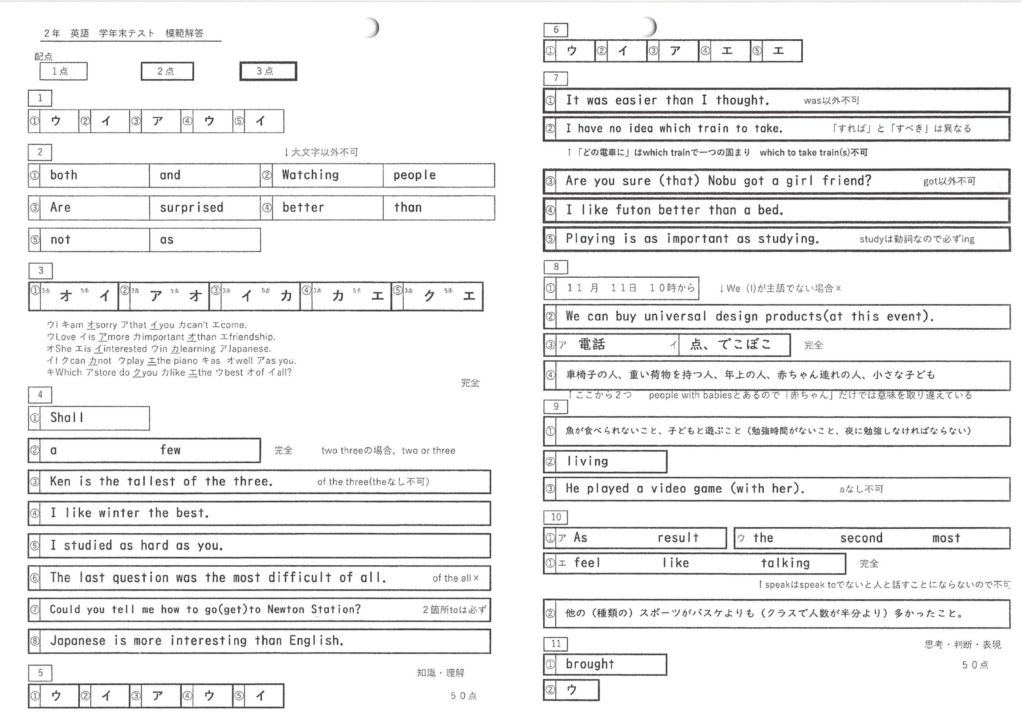
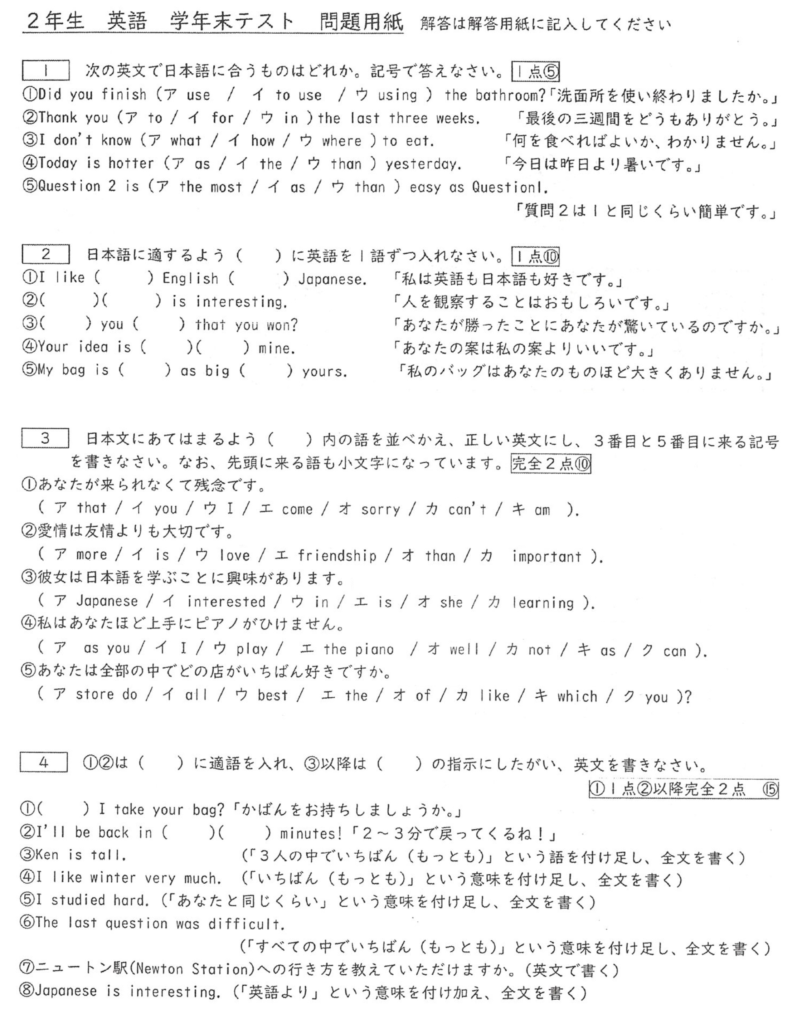
大問1の解説
① Did you finish (ア use / イ to use / ウ using) the bathroom?
「洗面所を使い終わりましたか。」
使い終わるを言いかえると「『使うこと』を終える」なので、
to useか、usingだとわかる
ここがポイント!
動詞の「finish」の後ろは「to 動詞の原形」ではなく
「動詞ing」の形が来る。
だから、ウの「using」が正解。
② Thank you (ア to / イ for / ウ in) the last three weeks.
「最後の三週間をどうもありがとう。」
Thank you forはセットで覚えよう!
だから、イの「for」が正解。
③ I don’t know (ア what / イ how / ウ where ) to eat.
「何を食べればよいか、わかりません。」
「何を食べればよいか」はwhat to eat
だから、アの「what」が正解。
④ Today is hotter (ア as / イ the / ウ than ) yesterday.
「今日は昨日より暑いです。」
英文を見ると、hotの比較級hotterがあり、
日本文を見ても比較の「より」があるので、
ウの「than」が正解。
⑤ Question 2 is (ア the most / イ as / ウ than ) easy as Questionl
「質問2は1と同じくらい簡単です。」
日本文を見ると「同じくらい簡単」とあり、
英文にも「easy as」と続くので、「as 形容詞 as」だとわかる。
だから、イの「as」が正解。
大問2の解説
2 日本語に適するよう( )に英語を1語ずつ入れなさい。
① I like ( both ) English ( and ) Japanese.
「私は英語も日本語も好きです。」
「AもBも」は both A and B を使います。
both … and … = AもBも
② ( Watching )( people ) is interesting.
「人を観察することはおもしろいです。」
「人を観察することは」が主語。
「観察すること」の「すること」は 動詞のing形を使うので「watching」
「人を」のような『を』がつく言葉は、動詞のすぐ後ろに入れる。
だから、「人を観察すること」は、「watching people」になる。
③ ( Are ) you ( surprised ) that you won?
「あなたが勝ったことにあなたが驚いているのですか。」
「〜に驚いている」は be surprised を使います。
※この場合の「be」は主語が you なので「are」になる。←わからないときは聞いてね
疑問文なのでbe動詞を先頭に持ってきて「Are you surprised … ?」となる。
④ Your idea is ( better )( than ) mine.
「あなたの案は私の案よりいいです。」
「〜より良い」は「better than 〜」を使う。
※「私の案 my idea」は「私のもの」に言い替えて「mine」となる。
⑤ My bag is ( not ) as big ( as ) yours.
「私のバッグはあなたのものほど大きくありません。」
「・・・ほど〜ない」は「not as 〜 as ・・・」を使う。(〜の部分は形容詞)
だから、「not as big as …」(…ほど大きくない)となる。
大問3の解説
① あなたが来られなくて残念です。
(ア that / イ you / ウ I / エ come / オ sorry / カ can’t / キ am)
<並び替え>I am sorry that you can’t come.
<解答>3番目:オ(sorry)、5番目:イ(you)
※「〜して残念だ」= I am sorry that …
※ you can’t come(あなたが来られない ⇒ あなたは来ることができない)
② 愛情は友情よりも大切です。
(ア more / イ is / ウ love / エ friendship / オ than / カ important)
<並び替え>Love is more important than friendship.
<解答>3番目:ア(more)、5番目:オ(than)
③ 彼女は日本語を学ぶことに興味があります。
(ア Japanese / イ interested / ウ in / エ is / オ she / カ learning)
<並び替え>She is interested in learning Japanese.
<解答>3番目:イ(interested)、5番目:カ(learning)
※「〜に興味がある」= be interested in …
※「〜を学ぶこと」= learning Japanese(動名詞)
④ 私はあなたほど上手にピアノがひけません。
(ア as you / イ I / ウ play / エ the piano / オ well / カ not / キ as / ク can)
<並び替え>I can not play the piano as well as you.
<解答>3番目:カ(not)、5番目:エ(the piano)
※「〜ほど…できない」= can not … as 〜 as …
⑤ あなたは全部の中でどの店がいちばん好きですか。
(ア store do / イ all / ウ best / エ the / オ of / カ like / キ which / ク you)?
<並び替え> Which store do you like the best of all?
<解答>3番目:ク(you)、5番目:エ(the)
※並び替えた時に「do」が3番目になるが、
「store do」が1つの選択肢になっているので、
3番目は、クのyouになる!(引っかからないように!)
大問4の解説
①( Shall )I take your bag?
「かばんをお持ちしましょうか。」
※「〜しましょうか?」は Shall I … ?
② I’ll be back in( a )( few )minutes!
「2~3分で戻ってくるね!」
※「2〜3の(少しの)」は a few
だから a few minutesで2〜3分。
③ Ken is tall.
(「3人の中でいちばん(もっとも)」という語を付け足し、全文を書く)
<解答>Ken is the tallest of the three.
※形容詞「tall」を最上級のtallestにする
最上級の形なので、tallestの前に『the』、
後ろに「3人の中で」の『of the three』
④ I like winter very much.
(「いちばん(もっとも)」という意味を付け足し、全文を書く)
<解答>I like winter the best.
※「いちばん好き」は「like … the best」
(very much を the best に置き換える)
⑤ I studied hard.
(「あなたと同じくらい」という意味を付け足し、全文を書く)
<解答>I studied as hard as you.
※「同じくらい」は『as 〜 as』
「同じぐらい一生懸命に」なので『as hard as』
⑥ The last question was difficult.
(「すべての中でいちばん(もっとも)」という意味を付け足し、全文を書く)
<解答>The last question was the most difficult of all.
※「いちばん難しい」は difficult の前に the mostをつけて『the most difficult』
※「すべての中で」は 『of all』
⑦ ニュートン駅(Newton Station)への行き方を教えていただけますか。
(英文で書く)
<解答>Could you tell me how to get to Newton Station?
※道を尋ねる定番表現なので、丸暗記すること!
Could you tell me how to get to … ?
(get は go でも良いが、普通は使わない)
⑧ Japanese is interesting.
(「英語より」という意味を付け加え、全文を書く)
<解答>Japanese is more interesting than English.
※形容詞が比較的スペルが長い interesting なので
『〜er than』ではなく『more 〜 than …』を使う。
大問7の解説
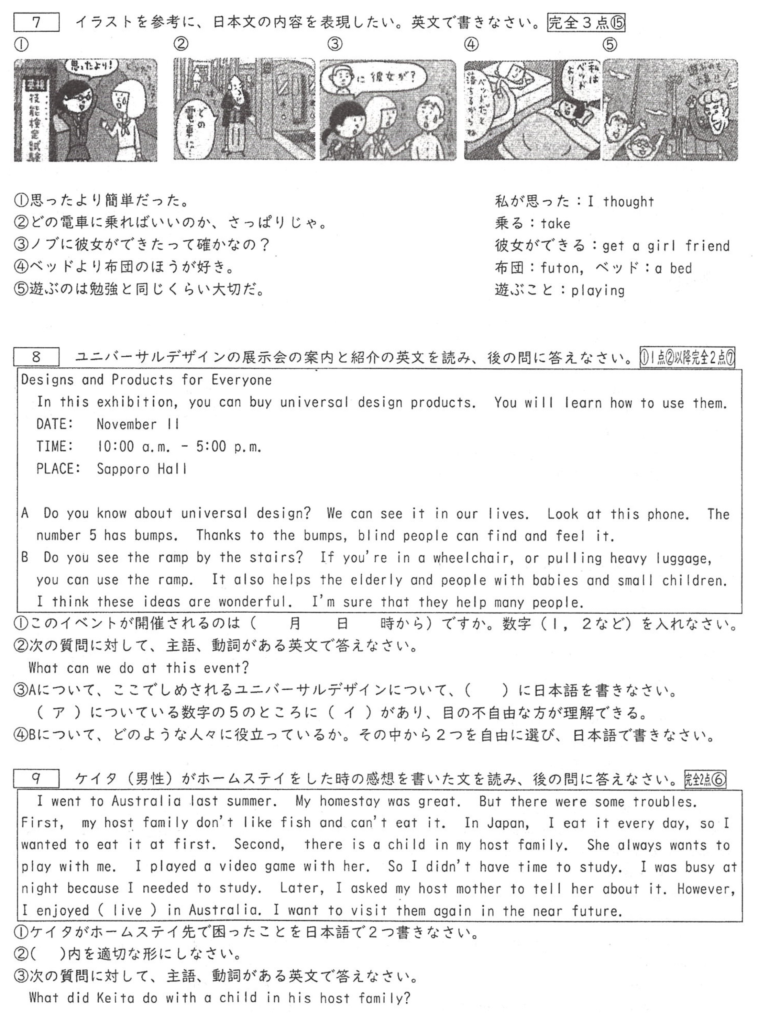
この問題は学校ワークの問題ですが、下記のように考えると解けます。
丸暗記よりも、下記の方法でやることで、他の問題も解けるようになります。
① 思ったより簡単だった。
<解答> It was easier than I thought.
<考え方>1)主語を加えて考える
それは私が思ったよりも簡単だった
2)並び替える
それは簡単だった /私が思ったより
3)英語に変える(〜よりも⇒〜er than)
It was easier / than I thought
② どの電車に乗ればいいのか、さっぱりじゃ。
<解答> I have no idea which train to take.
<考え方>1)主語を加えて考える
私はどの電車に乗ればいいのか、わからない。
2)並び替える
私はわからない /どの電車に乗ればいいのか
3)英語に変える
※どれに乗れば良いのか⇒which to take
※どの電車に乗れば良いのか⇒which train to take
I have no idea / which train to take
③ ノブに彼女ができたって確かなの?
<解答> Are you sure that Nobu got a girl friend?
<考え方>1)主語を加えて考える
※ノブに彼女ができた⇒ノブが彼女を得た
ノブが彼女を得たというのは確かですか
2)並び替える
確かですか/というのは/ノブが彼女を得た
3)英語に変える
Are you sure / that / Nobu got a girl friend
※thatは省略可
④ ベッドより布団のほうが好き。
<解答> I like futon better than a bed.
<考え方>1)主語を加えて考える
私はベッドより布団のほうが好き
2)並び替える
私は布団が好き /ベッドよりも
3)英語に変える
I like futon / better than a bed
⑤ 遊ぶのは勉強と同じくらい大切だ。
<解答> Playing is as important as studying.
<考え方>1)主語を明確にする
遊ぶことは勉強することと同じくらい大切だ
2)並び替える
遊ぶことは同じくらい大切だ /勉強することと
3)英語に変える(と同じくらい〜⇒ as 〜 as)
Playing is as important as /studying
大問8の日本語訳
Designs and Products / for Everyone
デザインと製品 /みんなのための
In this exhibition, / you can buy /universal design products.
この展示会では /あなたは買うことができる /ユニバーサルデザインの製品を
You will learn /how to use /them.
あなたは学ぶでしょう /どのように使うのか /それらを
DATE: November 11
TIME: 10:00a.m. – 5:00 p.m.
PLACE: Sapporo Hall
A: Do you know /about universal design?
あなたは知っていますか /ユニバーサルデザインについて
We can see /it /in our lives.
わたしたちは見ることができる /それを /わたしたちの生活の中で
Look at this phone.
この電話を見て
The number 5 has bumps.
その数字の5は突起があります
Thanks to the bumps, /blind people /can find and feel /it.
この突起のお陰で /目の不自由な人々は /見つけて触るることができる /それを
B: Do you see /the ramp /by the stairs?
あなたは見えますか /スロープが /階段のそばの
If you’re /in a wheelchair, or pulling heavy luggage, /you can use /the ramp.
もしあなた〜だったら /車椅子に乗っていたり、重い荷物を引いている /あなたは使うことができる /スロープを
It also helps /the elderly /and people /with babies and small children.
それはまた助けます /高齢者 /そして人々 /赤ちゃんや小さな子供を連れた
I think /these ideas are wonderful.
私は思う /それらのアイデアは素晴らしいです
I’m sure that /they help many people.
きっと /それらはたくさんの人々を助けます
大問9の日本語訳
I went /to Australia /last summer.
私は行きました /オーストラリアへ /去年の夏
My homestay was great. /But there were /some troubles.
ホームステイはとても良かった。 /しかしあった /いくつか困ったことが
First, /my host family don’t like fish /and can’t eat it.
1つ目は /ホストファミリーは魚が好きではなかった /そしてそれを食べることができなかった
In Japan, /I eat it every day, /so I wanted to eat /it /at first.
日本では /毎日魚を食べている /だから私は食べたいと思った /それ(魚)を /最初は
Second, /there is a child /in my host family.
2番目に /一人の子どもがいました /ホストファミリーには。
She always /wants to play /with me.
彼女はいつも /遊びたがりました /私と
I played a video game /with her.
私はテレビゲームをしました /彼女と
So /I didn’t have time /to study.
だから /私は時間がなかった /勉強するための
I was busy /at night /because /I needed to study.
私は忙しかった /夜 /なぜなら /私は勉強する必要があった
Later, /I asked /my host mother /to tell her /about it.
後で /私はたのんだ /ホストマザーに /彼女に伝えるように /それについて
However, /I enjoyed /( live ) /in Australia.
しかし /私は楽しみました /生活することを /オーストラリアで
I want to visit /them /again /in the near future.
私は訪ねたい /彼らを /もう一度 /近い将来
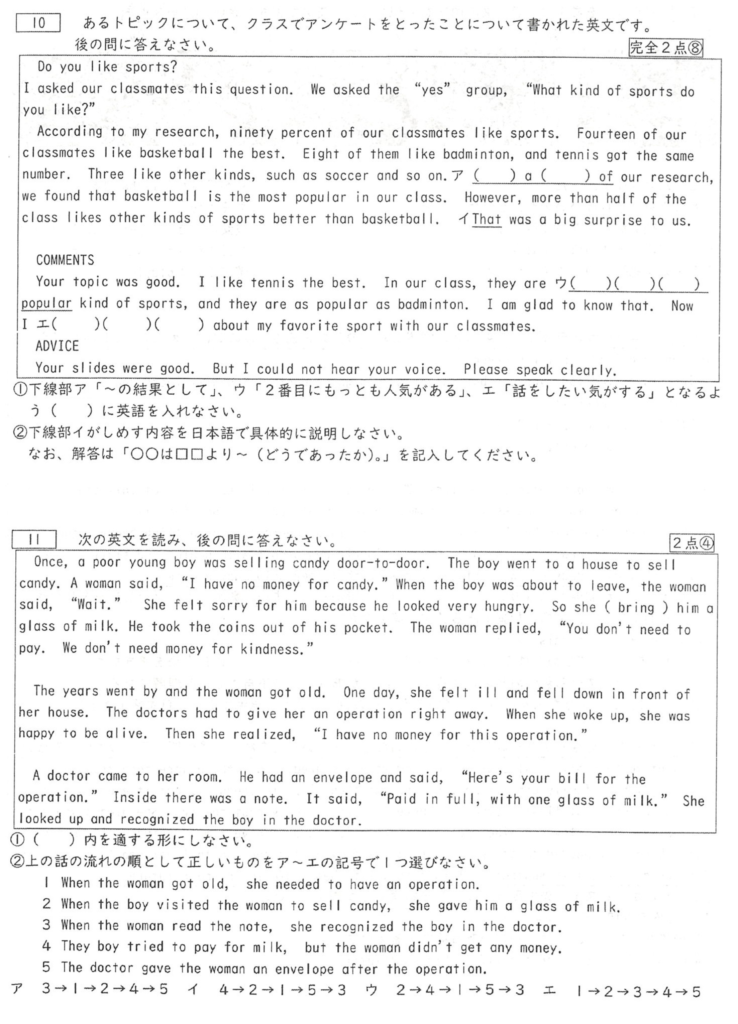
大問10の日本語訳
Do you like sports?
あなたはスポーツが好きですか。
I asked /our classmates /this question.
私は尋ねた /クラスメートにしました /この質問を
We asked /the “yes” group, /“What kind of sports do you like?”
わたしたちは尋ねた /「はい」のグループに /どんなスポーツが好きですか
According to my research, /ninety percent of our classmates /like sports.
私の調査によると /クラスメートの90%が /スポーツが好きです。
Fourteen of our classmates /like basketball /the best.
クラスメートの14人は /バスケットボールが好きです /一番
Eight of them /like badminton, /and tennis got /the same number.
彼らの8人は /バドミントンが好き /そしてテニスも得た /同じ数を
Three /like other kinds, /such as /soccer and so on.
3人は /他の種類が好き /例えば /サッカーやなど
( As ) a ( result ) /of our research, /we found /that basketball is the most popular /in our class.
結果によると /私たちの調査の、 /私たちは見つけた /バスケットボールがクラスで最も人気がある /私のクラスで
However, /more than half /of the class /likes other kinds of sports /better than basketball.
しかし /半数以上は /クラスの /他のスポーツのほうが好きです /バスケットボールより
That was a big surprise /to us.
それは大きな驚きでした /私たちにとって
COMMENTS(コメント)
Your topic was good.
あなたのテーマは良かったです。
I like tennis the best.
私はテニスが一番好きです。
In our class, /they are ( the )( second )( most ) popular /kind of sports, /and they are as popular as /badminton.
私たちのクラスでは /それらは2番目に人気のある /スポーツの種類で /そしてそれらは同じくらい人気があります /バドミントンと
I am glad /to know that.
私はうれしいです /それを知って
Now /I ( feel )( like )( talking ) /about my favorite sport /with our classmates.
今 /私は話したい気分です /お気に入りのスポーツについて /クラスメートと
ADVICE(アドバイス)
Your slides were good.
あなたのスライドは良かったです。
But /I could not hear /your voice.
しかし /私は聞くことができなかった /あなたの声を
Please speak clearly.
はっきり話してください。
大問11の日本語訳
Once, /a poor young boy /was selling candy /door-to-door.
昔 /貧しい少年が /キャンディーを売っていました /家から家へ
The boy went /to a house /to sell candy.
その少年は行った /1軒の家に /キャンディーを売るために
A woman said, /“I have no money /for candy.”
女性は言った /私はお金がない /キャンディーのための
When the boy was about to leave, /the woman said, /“Wait.”
少年が帰ろうとしたとき /女性は言いました /「待って」
She felt sorry /for him /because /he looked /very hungry.
彼女はかわいそうに感じた /彼を /なぜなら /彼は見えた /とてもお腹をすかせているように
So /she brought /him /a glass of milk.
そこで /彼女は持ってきた /彼に /一杯のミルクを
He took the coins out of /his pocket.
彼はコインを取り出した /彼のポケットから
The woman replied, /“You don’t need to pay. /We don’t need money /for kindness.”
女性は返事をした /「お金はいらないわ。 /わたしたちはお金は必要ない /親切に
The years went by /and the woman got old.
年月が過ぎ /そして女性は年を取りました。
One day, /she felt ill /and fell down /in front of her house.
ある日 /彼女は気分が悪くなり /そして倒れた /家の前で
The doctors had to give /her /an operation /right away.
医者たちは与えなければならない /彼女に /手術を /すぐに
When she woke up, /she was happy /to be alive.
彼女は目を覚ましたとき /彼女は喜んだ /生きていることを
Then /she realized, /“I have no money /for this operation.”
それから /彼女は気づきました /私はお金がない /この手術のための
A doctor came to her room.
医者が彼女の部屋にやって来た
He had an envelope /and said, /“Here’s your bill /for the operation.”
彼は封筒を持っていた /そして言った /これがあなたの請求書です /手術のための
Inside /there was a note.
中には /一枚のメモがあった
It said, /“Paid in full, /with one glass of milk.”
そこには書かれていた /全額支払い済み /一杯のミルクで
She looked up /and recognized /the boy /in the doctor.
彼女は顔を上げた /そして気づいた /その少年に /その医者の中に